Tren-Tech provides bridge jacking design to support contractors planning bridge maintenance and repair work. Our services cover lifting associated with bearing pad replacement, bent cap repairs and concrete restoration.
Project-specific temporary support
Engineering scope may include jack beams, jacking frames and shoring solutions tailored to the bridge and proposed work. Our approach includes finite element analysis to evaluate structural effects associated with the lifting operation.
Coordinate design with the repair work
Bridge jacking requirements depend on the existing structure and the planned construction operation. Provide available bridge drawings, repair plans, existing-condition information and proposed equipment when requesting engineering support. The required design information and deliverables will be confirmed during scope review.
Project spotlight: SH36 bridge jacking for TxDOT
Tren-Tech Company provided bridge jacking design for the State Highway 36 (SH36) project for the Texas Department of Transportation (TxDOT). This project is one example of our experience supporting contractors with project-specific bridge jacking engineering.
The project photo below shows the temporary steel support system and hydraulic jacking equipment beneath the bridge. It offers a look at the field work behind the design and the equipment arrangement used on this project.

Request bridge jacking engineering
Tell us where the bridge is located, what repairs are proposed and when the work is planned. Include owner or agency requirements available for the project so the engineering scope can address them.
For related support, explore our structural engineering and temporary shoring design services.
Request a project quote or call 972-304-2171. Explore all Tren-Tech engineering services.
Information needed for bridge jacking design
Include the bridge layout, span and support details, available structural drawings, repair limits and proposed jack locations. Describe the planned traffic condition during the work, equipment constraints and the intended lifting sequence. The required reactions, temporary load paths and supporting components are developed within the agreed engineering scope.
When field conditions change
Existing bridge information and actual conditions should be coordinated before the work proceeds. If the planned support arrangement, repair sequence or equipment changes, contact the engineering team for review. For broader construction questions, see our engineering consulting services.
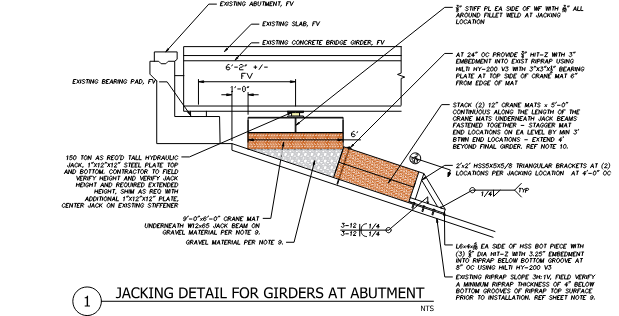
Bridge Jacking Design at an Abutment
Project 30160
Project 30160 illustrates Tren-Tech’s design for jacking bridge girders at an abutment. The section shows the existing bridge girder and bearing location in relation to a hydraulic jack and the temporary support arrangement below.
The detail identifies steel support members, crane mats, brackets and anchorage, together with their placement around the existing abutment and sloping riprap. Notes call for field verification of existing bridge components and site conditions. The drawing shows how the proposed lifting arrangement is coordinated with the structure and supporting surfaces.

For bridge jacking engineering, provide the available bridge drawings, proposed work, existing-condition information and planned equipment. Discuss your bridge jacking project or learn more about our bridge jacking design services.
